


Cyrano De Bergerac
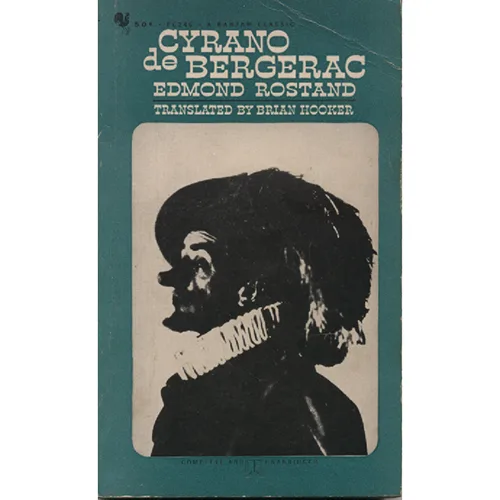
Publisher: Bantam
ISBN: none
Ah, "Cyrano de Bergerac," the 1964 edition by that daring purveyor of poetic drama, Edmond Rostand. You might wonder why this particular printing has found itself gathering dust on a shelf at Crappy Old Books, speaking volumes of its storied journey through the ages and the various owners who likely clutched it with fervor before relegating it to a life of solitude. Perhaps they discovered that a long nose was not the only thing that sets Cyrano apart from the crowd; it’s also his penchant for witty repartee and unrequited love—qualities that might have charmed the socks off many a Victorian lady but didn’t quite work out in the realm of modern dating.
In a world where love letters are as obsolete as dial-up internet, this tragicomic masterpiece might just revive your faith in the written word—or at least make you chuckle at the absurdity of it all. Imagine a gallant swordsman with a nose so remarkably prominent it has its own postal code, engaging in poetic duels while simultaneously swooning over the fair Roxane. But alas, our dear Cyrano is too busy playing the role of the chivalrous ghostwriter to capitalize on his own affections, offering the handsome but dim-witted Christian the chance to woo her. It’s a classic case of miscommunication that could give modern-day Tinder a run for its money.
Published by Bantam—an imprint that suggests a certain cheeky, rebellious spirit—this edition immerses you in a world where profanity was less about swearing and more about the acrobatics of language. In the hands of Rostand, words dance like fireflies at dusk, even as they weave a rather tragic tale of longing and self-doubt. The text is a linguistic buffet, offering a smorgasbord of eloquence that may have you questioning whether the real treasure lies in the words themselves or in the art of saying nothing at all, just like those awkward silences on first dates.
As you thumb through these pages, you’ll encounter enough melodrama to rival a soap opera and enough existential musings to fuel a Philosophy 101 class. Readers may be left pondering questions such as: Is it better to have loved and lost, or to have written an entire play about unreciprocated emotions? Can a nose truly be the arbiter of one’s fate? And, most importantly, how many times can you quote ’a nose’ in a single sitting before it stops being funny? The answers remain elusive, but the journey is undoubtedly entertaining.
Condition: This used copy has seen better days, much like Cyrano himself. It carries the faint scent of nostalgia and a few coffee stains from its previous owner’s late-night literary binges, suggesting moments of deep contemplation interspersed with the occasional caffeine-fueled epiphany. The spine is as flexible as Cyrano’s morals when it comes to love, and the pages are dog-eared in just the right places—proof of a well-loved volume that has been cherished, debated over, and perhaps even sighed at. You might even find a few marginal notes scattered throughout, revealing insights from a reader who clearly thought they were smarter than Rostand. Spoiler alert: they weren’t.
So, if you fancy a foray into the world of grandiloquent French literature that manages to be both heartwarming and heart-wrenching, this particular edition may just be your ticket to a whirlwind romance with the past. It beckons the reader to explore the profound depths of love, language, and the occasional existential crisis—all from the comfort of your own armchair.
In a world increasingly devoid of deep literary thought, this copy of "Cyrano de Bergerac" serves as a reminder of times when people actually wrote letters rather than sending emojis. Perhaps it’s time to reacquaint yourself with the art of eloquence, all thanks to a book that you can now call your own, courtesy of Crappy Old Books.
Keep browsing: See more Poetry books Other books by Edmond Rostand
